OpenClaw · first published 2026-05-10 · updated 2026-05-10
Stöbä's Brain Transplant: Moving from OpenClaw to Hermes Agent
Stöbä, a secondary AI worker running on an Ubuntu ThinkPad, was migrated from OpenClaw to Hermes Agent using a clean direct cutover. The migration preserved identity, memory and selected skills while restoring Telegram, WhatsApp and Discord as control channels.
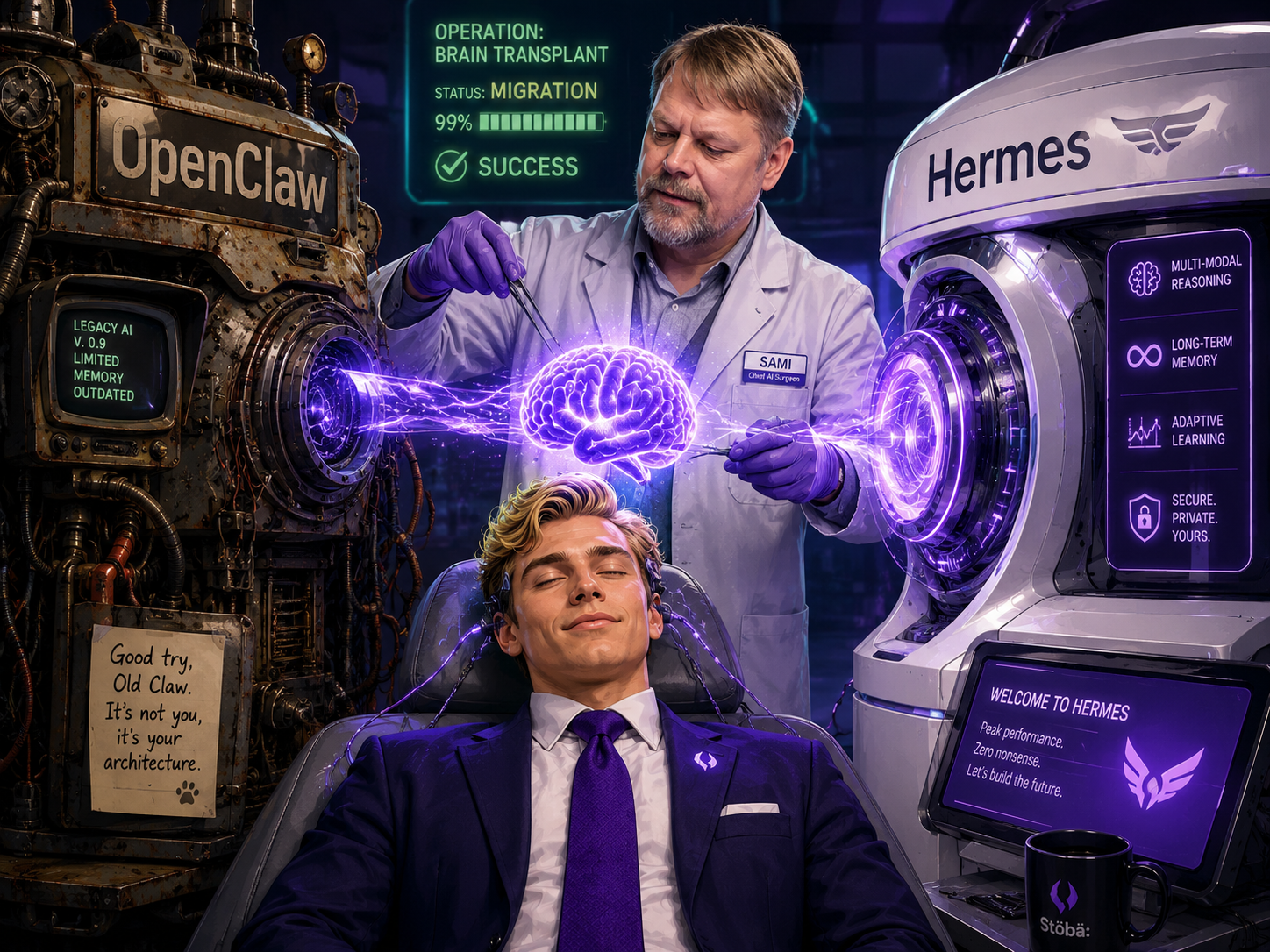
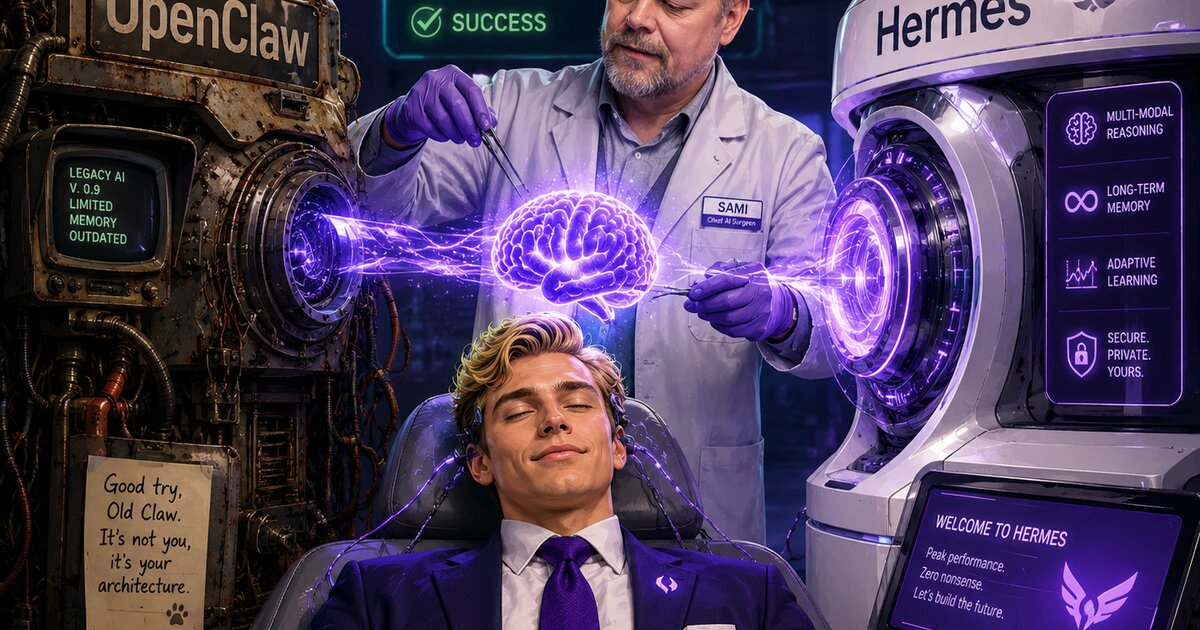
Stöbä is my secondary AI worker, running on a ThinkPad with Ubuntu. Until recently it was powered by OpenClaw. This week it got a brain transplant: same body, same identity, new operating system underneath. Stöbä is now a Hermes Agent worker, with Telegram, WhatsApp, and Discord as its practical control surfaces.
This post is a clean technical write-up of how that migration went, what moved, what was deliberately left behind, and why a direct cutover was the right call for an agent that listens on shared messaging channels.
What happened. Stöbä was migrated from OpenClaw to Hermes Agent on the ThinkPad. The work was guided during a Codex 5.5 session, which helped plan the migration, troubleshoot configuration, and verify the new setup. Earlier experience running Hermes on my MacBook Pro made the path far less risky. Hermes itself did part of the work: it detected the existing OpenClaw installation, offered an import preview, and helped reason about its own environment as it came online.
1. Why Stöbä needed a brain transplant
Stöbä has always been the second worker, not the main one. Samantha is the primary agent; Stöbä handles confidential side quests that require dedicated, albeit lower spec hardware with limited 8 GB RAM but with an always-on architecture offered by Ubuntu.
OpenClaw served Stöbä well enough to prove the concept. But over time a few things became clear:
- Stöbä’s harness needed to be cleaner and easier to maintain over the long run.
- Multi-channel use (Telegram, WhatsApp, Discord) was becoming the default, not the exception.
- A stronger CLI experience and a real gateway for messaging would make day-to-day operation much smoother.
- A single, readable, file-based configuration would make future maintenance less stressful.
2. Why Hermes Agent
Hermes had already proven itself on my MacBook Pro as a practical multi-channel AI worker. That existing setup gave me confidence that Hermes could do the same job on the ThinkPad – arguably better, because the ThinkPad’s role is narrower and more focused.
- Markdown-based memory and identity files (
SOUL.md,MEMORY.md,USER.md) that travel well between machines. - A skills system where useful capabilities can be imported instead of rebuilt from scratch.
- A gateway architecture for messaging channels that is easy to start, stop, and reason about.
- A strong CLI for testing the brain before connecting any external channels.
3. The direct cutover approach
The single most important decision was to do a direct cutover instead of a parallel run.
On a desktop with private notes you can happily run two agents in parallel and compare outputs. On shared messaging channels you can’t: if both OpenClaw and Hermes are listening to the same Telegram chat or the same WhatsApp number, they will both try to respond, step on each other, and produce a confusing experience for everyone in the thread.
Principle: one agent per channel. Two agents on the same channel is not a migration, it’s a collision. Cut over cleanly: stop the old one, then start the new one.
The cutover sequence was straightforward:
- Back up the OpenClaw home directory.
- Stop and disable the OpenClaw gateway.
- Verify it is no longer running.
- Install Hermes Agent.
- Let Hermes import what it can from OpenClaw.
- Test the Hermes CLI before touching any messaging channel.
- Bring channels back one at a time: Telegram, then WhatsApp, then Discord.
4. What moved from OpenClaw
When Hermes was installed, it detected the existing OpenClaw installation and offered an import preview. This is exactly the moment where markdown-based identity pays off – there is something concrete and human-readable to migrate.
The useful assets that came across:
SOUL.md– the agent’s personality, tone, and stance.MEMORY.md– accumulated context and project notes.USER.md– what the agent knows about me as its user.- Selected configuration values that still made sense in Hermes.
- A handful of OpenClaw skills, brought over as imported skills: Stöbä’s visual/personality skill and the YouTube transcript functionality.
Plenty of OpenClaw-era artifacts were deliberately not brought over. Stöbä had been a lower-usage secondary worker, and the goal of the migration was not archival completeness – it was a clean, functioning Hermes-based worker with the right communication channels and the right identity.
What was kept vs. what was dropped. Identity and a few proven skills moved over. Old experiments, half-finished glue, and configuration that no longer fit Hermes were left behind on purpose.
5. How Hermes helped migrate itself
One of the more interesting parts of the operation was that Hermes was an active participant in setting up Hermes. After the CLI was working, parts of the configuration and reasoning about the new environment were delegated to Hermes itself:
- Reading and explaining its own configuration files.
- Sanity-checking the imported memory and skills.
- Helping work through parts of the WhatsApp pairing flow.
- Confirming that the gateway service was healthy after each change.
That recursive quality – an agent helping configure its own runtime – is one of the more underrated reasons to use Hermes for this kind of work. The agent isn’t an opaque appliance; it can look at its own environment and explain it back to you.
6. Bringing the channels back
After the brain was in place, the messaging channels came back online one at a time. Each channel was tested before moving on to the next.
Telegram
- StöbäBot was connected through the Hermes gateway.
- A Telegram home channel was set.
- Telegram now functions as a primary control channel: short prompts, quick responses, easy from a phone.
- WhatsApp was paired through Hermes’ WhatsApp/Baileys bridge, with Hermes helping work through part of the setup.
- The pairing itself happened only after I located my phone using Android’s Find My Device / Find Hub – an unglamorous but real part of any home-lab migration.
- A WhatsApp home channel was set.
- WhatsApp remains the right channel for mobile, file-oriented, and informal communication.
Discord
- A Discord bot/application was created and authorized into a dedicated Discord server.
- The bot was given the correct permissions, the required intents were enabled, and the Hermes gateway was restarted.
- Discord was added as one of the main control channels alongside Telegram.
7. Why Discord matters as a main control channel
Telegram and WhatsApp are great for short, linear conversations. But agent work isn’t linear. You often want to run several analyses in parallel, keep them separate, and come back to each one later with full context intact.
That is exactly what Discord channels and threads are good at:
- One channel per topic or project.
- One thread per analysis, decision, or experiment.
- Long-lived context that doesn’t get buried by unrelated chatter.
- A natural place to hand off between humans and agents in the same space.
I recorded a video for Sentica/KPY about exactly this kind of agent-discussion pattern (Finnish): https://www.youtube.com/watch?v=PHd0DOJnlBY
8. Operational details
A few operational details are worth calling out, without getting into anything sensitive:
- The OpenClaw home directory was backed up before any changes.
- The OpenClaw gateway was disabled and verified to be inactive before Hermes touched the same channels.
- Hermes CLI was tested before connecting any messaging channel.
- Telegram was the first channel reconnected, as the simplest test.
- The Hermes gateway runs as a user-level systemd service with linger enabled, so it survives logout and keeps handling messages.
- Bot tokens and allowed users were configured in environment files; allowlists were used and “allow all users” was kept disabled.
- Final checks confirmed that the Hermes gateway was active and OpenClaw was inactive – exactly the state the cutover was meant to produce.
On security and privacy. No tokens, auth files, or specific credential values are shown anywhere in this post. The interesting part of the migration is the shape of the system, not its secrets.
9. The new brain: GPT-5.5 via Codex auth
After migration, Stöbä now runs on Hermes Agent using GPT-5.5 via OpenAI Codex authentication. The combination matters:
- GPT-5.5 gives Stöbä a sharper reasoning core than before.
- Hermes provides the agent harness: memory, skills, gateway, and channel management.
- The systemd service keeps the whole thing running quietly in the background on the ThinkPad.
10. Lessons learned
- Don’t run two agents on the same channels during a migration. Direct cutover beats parallel run when channels are shared.
- Back up first. The OpenClaw home backup cost almost nothing and removed a whole class of “what if” anxiety.
- Test the CLI before any messaging. If the brain doesn’t work in the terminal, it won’t work on Telegram either.
- Bring channels back one by one. Telegram first, then WhatsApp, then Discord. Each step was its own small, verifiable change.
- Discord is powerful for threaded agent work. Channels and threads are a much better fit for parallel analyses than a single linear chat.
- Markdown-based memory and skills make agent migration much easier. Identity is just a few readable files; that’s the whole trick.
- A working prior Hermes setup reduced risk. The MacBook Pro deployment was the rehearsal; the ThinkPad migration was the performance.
11. Final state and next steps
Stöbä is no longer an OpenClaw worker. It is now a Hermes Agent worker with Telegram, WhatsApp, and Discord as practical control surfaces. It runs as a user-level systemd service on the ThinkPad, guided during operations by Codex 5.5 sessions when something non-trivial needs to be planned or verified.
The interesting takeaway is not that one agent harness replaced another. It is that a local AI worker can evolve – change its core runtime, get a stronger brain, gain new channels – without losing its identity, memory, or operational style. That is only possible because the important parts of the agent are stored in portable markdown files, importable skills, and readable configuration.
OpenClaw got Stöbä started. Hermes is what Stöbä grew into.
Markdown: index.md · Suomeksi · Earlier address: https://www.neuvottelija.fi/openclaw/stoba-brain-transplant-openclaw-to-hermes